Source: http://www.rotaryclubofbangkok.org/
Rotary Club is a worldwide charity organization who helps the less fortunate in the world. With 1.2 million volunteers in 33.000 clubs spreaded over the world they work in local areas. They try to combat hunger, improve health and sanatation, provide education and job training, promote peace and eradicate polio.
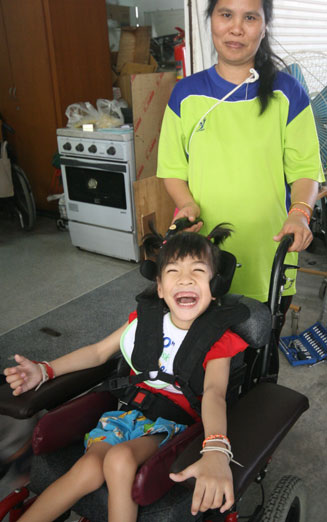
And here is an example of what they do. I came accross pictures of a facebook friend in Thailand. Her name is Amy and her FB is Anantarak Hua Hin. She is the director of Anantarak Health Training School in Hua Hin, Thailand. In one of these pictures she and a banner of Rotary Club Bangkapi were captured. I looked through all the pictures and loved what I saw. The volunteers helping disabled children and the children, some in a wheelchairs, smiling of joy and happiness made my heart week. So I wrote her a message that next time I want to help out. Being in a wheelchair myself since childhood I can be an example of how important good health care and education is to handicapped children.
The only thing I hope what Rotary and the local volunteerd will do is try to make the local schools accessible for disabled children. Then they can grow up with their friends, living at home with their parents and getting help from class mates and try to cope with everyday life.
Sometimes this is easier than expected. A ramp to access the school and one wheelchair accessible toilet. The only thing the need is a wheelchair. But there are several projects running in Thailand where Thai volunteers import second hand wheelchairs from Europe like the Father Ray Foundation.
This Blog publishes articles to increase awareness around the world for disabled local people living in Thailand. Government policies, surveys, charity organisation, local initiatives, accessibility of public places are just a few items which will get attention through postings. Therefore we invite people to write about their subject to Disability.in.Thailand@gmail.com .
Showing posts with label wheelchairs. Show all posts
Monday, February 14, 2011
Sunday, January 9, 2011
Wheelchair project looking for volunteers.
Source: http://www.ricd.go.th/jvalun/index.htm
The disability problem in Thailand is so big that the government cannot tackle it alone – we play a fundamental role in helping people who would not otherwise get any help.
The number of people waiting for wheelchairs and other mobility aids is put at more than 200,000 by Dr Samai Sirithongthaworn, the RICD Director. And their conditions are often desperate.
Poverty is a major cause of disabilities - and often the result of disabilities resulting from accidents. This means people living in environments where they can do no more than survive. This in turn causes depression and apathy, a cycle of despair that can be broken with help from RICD and its Wheelchair Project.
“What we come across in home visits can make a strong person cry,” said Luke, the volunteer leader of the project. “I have cried when I have seen how some people have been suffering. But we can help them. We try to change their lives.
“We see children, maybe six or seven years old, lying in a dark room. They have never seen daylight. Their parents have no knowledge of what to do for them. They just lie there, all the time, and they have never been out because there are no mobility aids for them, no one to show their parents how to help them. No one realizes the children can be helped, could one day go to school, some even to university.”
Their carers, too, desperately need help but they have no one to turn to – even if they live in the same city street as other disabled people, they probably do not know each other and have no network to share information and support.
Adults, as well as children, are often condemned to hopeless, inactive lives after being disabled in accidents, through illness or by birth. With mobility aids and training, they can get work, provide for their families and contribute to their communities.
The problem is just as acute for the elderly. During a home visit, volunteers met one woman in her 90s. She had not been out for 20 years because she could not walk. "We gave her a wheelchair and the first thing she wanted to do was to go to church … we got there and found there was no access for wheelchairs, so we built one there and then," said Luke.
"Getting a mobility aid is a life-changing experience: it gives the person feet. It means they can live a normal life instead of being trapped by their bodies.
"Many children, who without a wheelchair would be confined in their homes, can go to mainstream schools. Others can go to special education centers for children with disabilities. When they are adults, they can reach amazing levels … some are graduates, managers and writers, others find their places in trades or businesses. And all because, at a critical time in their lives, we were able to give them feet and enable them to work for their futures."
An enormous area of work is education: parents’ love is often reduced to a day-to-day battle to cope because of the lack of knowledge about what can be done for, and by, people with disabilities. The Wheelchair Project’s parent organization, RICD, also tackles this problem
If you give a person feet, you can turn despair into hope and happiness and has a major commitment to telling everyone about the help and treatment available for children with disabling conditions.
This lack of knowledge is found everywhere among carers. It is also a big problem in health, community and education professionals, although the Wheelchair Project volunteers see the situation improving with government and RICD efforts.
Ten years ago, a healthcare professional told the RICD Wheelchair Project volunteers not to waste effort on a group of “hopeless” disabled children: the volunteers did put in the effort and now those children live constructive and happy lives. Some even go to university. Today, that experience is a guiding light for the RICD Wheelchair Project.
RICD and its Wheelchair Project are beginning to consider ways of supporting neighboring countries which have far fewer, if any, facilities to help people with disabilities. Links have already been forged with Laos and education is being offered to health professionals from Myanmar and Cambodia.
Visitors to Thailand may conclude disability is not a problem because it is rare to see disabled people on the streets.
But the reality is the nightmare of being trapped by disability in a society where there are too few mobility aids and the streets are too difficult to negotiate by any but the able bodied.
The disability problem in Thailand is so big that the government cannot tackle it alone – we play a fundamental role in helping people who would not otherwise get any help.
The number of people waiting for wheelchairs and other mobility aids is put at more than 200,000 by Dr Samai Sirithongthaworn, the RICD Director. And their conditions are often desperate.
Poverty is a major cause of disabilities - and often the result of disabilities resulting from accidents. This means people living in environments where they can do no more than survive. This in turn causes depression and apathy, a cycle of despair that can be broken with help from RICD and its Wheelchair Project.
“What we come across in home visits can make a strong person cry,” said Luke, the volunteer leader of the project. “I have cried when I have seen how some people have been suffering. But we can help them. We try to change their lives.
“We see children, maybe six or seven years old, lying in a dark room. They have never seen daylight. Their parents have no knowledge of what to do for them. They just lie there, all the time, and they have never been out because there are no mobility aids for them, no one to show their parents how to help them. No one realizes the children can be helped, could one day go to school, some even to university.”
Their carers, too, desperately need help but they have no one to turn to – even if they live in the same city street as other disabled people, they probably do not know each other and have no network to share information and support.
Adults, as well as children, are often condemned to hopeless, inactive lives after being disabled in accidents, through illness or by birth. With mobility aids and training, they can get work, provide for their families and contribute to their communities.
The problem is just as acute for the elderly. During a home visit, volunteers met one woman in her 90s. She had not been out for 20 years because she could not walk. "We gave her a wheelchair and the first thing she wanted to do was to go to church … we got there and found there was no access for wheelchairs, so we built one there and then," said Luke.
"Getting a mobility aid is a life-changing experience: it gives the person feet. It means they can live a normal life instead of being trapped by their bodies.
"Many children, who without a wheelchair would be confined in their homes, can go to mainstream schools. Others can go to special education centers for children with disabilities. When they are adults, they can reach amazing levels … some are graduates, managers and writers, others find their places in trades or businesses. And all because, at a critical time in their lives, we were able to give them feet and enable them to work for their futures."
An enormous area of work is education: parents’ love is often reduced to a day-to-day battle to cope because of the lack of knowledge about what can be done for, and by, people with disabilities. The Wheelchair Project’s parent organization, RICD, also tackles this problem
If you give a person feet, you can turn despair into hope and happiness and has a major commitment to telling everyone about the help and treatment available for children with disabling conditions.
This lack of knowledge is found everywhere among carers. It is also a big problem in health, community and education professionals, although the Wheelchair Project volunteers see the situation improving with government and RICD efforts.
Ten years ago, a healthcare professional told the RICD Wheelchair Project volunteers not to waste effort on a group of “hopeless” disabled children: the volunteers did put in the effort and now those children live constructive and happy lives. Some even go to university. Today, that experience is a guiding light for the RICD Wheelchair Project.
RICD and its Wheelchair Project are beginning to consider ways of supporting neighboring countries which have far fewer, if any, facilities to help people with disabilities. Links have already been forged with Laos and education is being offered to health professionals from Myanmar and Cambodia.
Visitors to Thailand may conclude disability is not a problem because it is rare to see disabled people on the streets.
But the reality is the nightmare of being trapped by disability in a society where there are too few mobility aids and the streets are too difficult to negotiate by any but the able bodied.
Labels:
accidents,
disability,
disabled,
disabling,
family,
helping people,
illness,
mobility aids,
school,
support,
training,
volunteers,
wheelchair project,
wheelchairs,
work
Subscribe to:
Posts (Atom)